
Cloud Native Applications
Kubernetes vs Serverless for Canadian Product Teams
A practical comparison of orchestration and serverless models for velocity, control, and operational ownership.
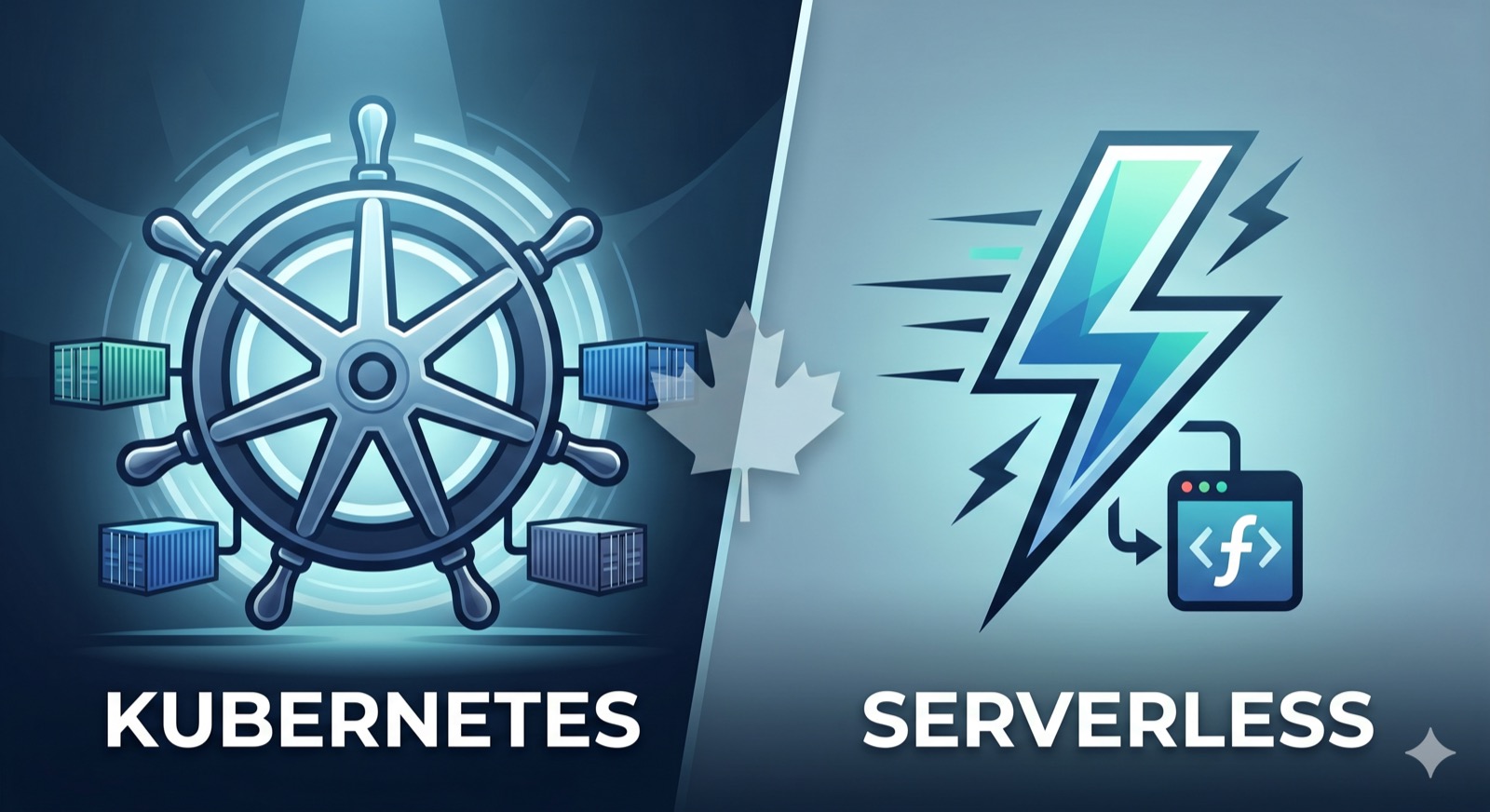
This Is a Portfolio Decision, Not a Platform Debate
Kubernetes and serverless are both valid, but they optimize different constraints. Serverless favors rapid delivery, event-driven elasticity, and reduced infrastructure management overhead. Kubernetes favors workload control, consistent runtime abstraction, and multi-service operational governance.
The right answer is often mixed. Treat architecture choice at the workload level: latency sensitivity, burst pattern, dependency topology, compliance boundaries, and team operations maturity should guide selection.
When Serverless Is the Better Choice
Serverless is strong for asynchronous processing, API backends with variable demand, automation jobs, and workflows where event-driven patterns dominate. The AWS Serverless Applications Lens provides practical design guidance across compute, data, messaging, deployment, and observability layers.
Teams with limited SRE capacity usually realize value faster with serverless because many operational concerns are abstracted by the platform. This can reduce time-to-market and allow engineering teams to focus on domain behavior rather than cluster operations.
When Kubernetes Is the Better Choice
Kubernetes is often better for long-running services, complex service meshes, custom runtime requirements, or workloads that require deep networking and scheduling controls. It is also useful for organizations standardizing multi-team platform practices across heterogeneous applications.
That flexibility comes with operational responsibility. Cluster lifecycle, security posture, upgrades, policy enforcement, and capacity planning require mature platform ownership. Without this operating model, Kubernetes can increase delivery friction.
Security and Reliability Considerations
Regardless of platform, reliability engineering must be explicit. AWS reliability guidance and Kubernetes security best practices both emphasize failure design, automation, and continuous recovery testing. Reliability is not inherited automatically from orchestration technology.
Security posture should include identity boundaries, workload isolation, secrets management, and policy controls. Teams should evaluate security controls against workload risk and regulatory context rather than assuming one platform category is inherently safer.
Practical Recommendation
Use serverless for event-driven and rapidly iterating product surfaces. Use Kubernetes where runtime control and platform standardization are strategic requirements. Keep interfaces consistent so workloads can evolve over time without full rewrites.
For Canadian product teams, hybrid portfolios frequently produce the best balance of speed, control, and cost. The key is disciplined architecture governance and clear ownership of operational responsibilities.
Strategic Context and Business Constraints
A reliable Kubernetes vs Serverless for Canadian Product Teams implementation starts with a clear definition of business constraints before technical architecture. Teams should explicitly document service-level targets, compliance obligations, escalation boundaries, and ownership expectations at the start of delivery. This is especially important in enterprise environments where one workflow touches product, operations, security, and customer experience teams at the same time. A long-form strategy document should describe the current-state process, quantify bottlenecks, and identify the smallest production-safe pilot that can generate trustworthy operational data. This turns architecture from opinion into measurable decision-making.
For this topic, the most common failure mode is over-indexing on model capability while under-investing in process readiness and governance controls. In practice, durable outcomes come from decision records, clear interface contracts, and measurable acceptance criteria. You should define what “good” looks like using operational indicators tied to outcome quality, not just speed. Where possible, baseline values should be captured over at least one full business cycle, including spikes and non-ideal states, so the rollout model reflects real production behavior rather than optimistic averages.
Cross-functional alignment should include at least four dimensions: technical architecture, policy and legal boundaries, support operations design, and ongoing change management. The architecture track defines runtime boundaries and integration contracts. The policy track defines what is allowed, restricted, and approval-gated. The operations track defines queueing, ownership, and incident response. The change-management track defines training, release communication, and adoption support. Without all four, teams launch quickly but plateau with avoidable regressions.
A practical long-form implementation plan should include a phased release timeline with explicit rollback criteria. Phase one should target narrow scope and high observability. Phase two should introduce controlled autonomy or broader integration. Phase three should standardize repeatable delivery patterns for adjacent workflows. Each phase should have quality gates, policy checks, and release-readiness checkpoints to keep risk proportional to blast radius. This is the most reliable way to scale safely when stakeholders have mixed risk tolerance and different time horizons.
Architecture decisions also need explicit dependency maps. Teams should list every upstream system, data source, and downstream action path involved in the workflow. Each dependency should be scored for reliability, ownership, and failure impact. This makes integration risk visible early and helps prioritize resilience engineering work. In many programs, dependency risk is a larger predictor of delivery delays than model behavior itself. Addressing this systematically improves both release predictability and service quality outcomes.
Finally, strong programs treat documentation as a production control surface, not an afterthought. Decision logs, runbooks, failure-taxonomy references, and escalation matrices reduce operational ambiguity during incidents and onboarding. In long-lived systems, this institutional memory is what enables teams to improve quality quarter after quarter. For Kubernetes vs Serverless for Canadian Product Teams, the target outcome is not only feature delivery, but a maintainable operating model that can adapt as business requirements evolve. Relevant focus areas include Kubernetes vs serverless, cloud architecture Canada, DevOps strategy.
Terraform baseline for production-ready service boundaries
variable "service_name" {
  type = string
}

resource "aws_cloudwatch_log_group" "service" {
  name              = "/rattix/${var.service_name}"
  retention_in_days = 30
}

resource "aws_iam_role" "task" {
  name = "${var.service_name}-task-role"
  assume_role_policy = jsonencode({
    Version = "2012-10-17"
    Statement = [{
      Effect = "Allow"
      Principal = { Service = "ecs-tasks.amazonaws.com" }
      Action = "sts:AssumeRole"
    }]
  })
}

resource "aws_security_group" "service" {
  name   = "${var.service_name}-sg"
  vpc_id = var.vpc_id
}
Architecture Blueprint and Integration Contracts
A production architecture should be decomposed into deterministic layers: interface intake, routing and orchestration, policy enforcement, tool execution, persistence and analytics, and monitoring. Each layer should expose explicit contracts and failure semantics. For example, intake should validate schema and identity context before orchestration. Orchestration should classify task intent, choose allowed execution paths, and enforce retry limits. Policy enforcement should run before side-effecting operations. Tool execution should be scoped, auditable, and least-privileged. Persistence should separate operational records from analytical aggregates.
When teams build without explicit contracts, failures become hard to classify and debug. A resilient design should specify which failures are retryable, which are user-correctable, and which require human escalation. This distinction helps prevent infinite retry loops, duplicate actions, and silent quality regressions. Contract-first design is particularly valuable for systems integrating AI responses with business actions. The model can assist interpretation, but action paths should remain deterministic, schema-validated, and policy-bounded where business risk is non-trivial.
Integration contracts should include data provenance and confidence metadata. If a response relies on retrieved context, include source references, retrieval timestamps, and confidence thresholds in the decision trace. If an action is generated from inferred intent, include risk score and policy outcome in the audit trail. This metadata is essential for root-cause analysis and compliance review. Without it, teams struggle to explain why decisions were made and cannot effectively tune behavior after incidents or near misses.
A common enterprise pattern is to adopt event-driven integration for decoupling and reliability. Intake events enter a queue or stream, orchestration workers process normalized payloads, and downstream actions publish outcome events for analytics and monitoring. This pattern improves resilience under load and supports replay-based debugging. It also allows teams to iterate on classification and policy logic without destabilizing source systems. For customer-facing workflows, event-driven architectures can reduce latency spikes during peak demand while preserving traceability.
Security boundaries should be embedded into architecture design from day one. Least-privilege IAM, scoped API tokens, secret rotation, and network segmentation should be enforced by default templates. In systems that include AI decisioning, policy checks should run prior to tool calls and before outbound communications. For sensitive workflows, require explicit approvals and dual validation for irreversible operations. This posture reduces attack surface and supports safer scaling as service complexity grows.
Monitoring should include both platform and product metrics. Platform metrics cover latency, error rates, retries, and dependency health. Product metrics cover user outcome quality, resolution rates, containment quality, and repeat-contact patterns. When these two views are unified, teams can distinguish infrastructure incidents from decision-quality issues and prioritize the right fixes. For Kubernetes vs Serverless for Canadian Product Teams, architecture quality should be measured by sustained reliability improvements, not one-time launch success.
Kubernetes deployment with conservative rollout policy
apiVersion: apps/v1
kind: Deployment
metadata:
  name: kubernetes-vs-serverless-canada
spec:
  replicas: 3
  strategy:
    type: RollingUpdate
    rollingUpdate:
      maxUnavailable: 0
      maxSurge: 1
  selector:
    matchLabels:
      app: workload
  template:
    metadata:
      labels:
        app: workload
    spec:
      containers:
        - name: app
          image: ghcr.io/rattix/service:stable
          ports:
            - containerPort: 8080
          resources:
            requests:
              cpu: "250m"
              memory: "256Mi"
            limits:
              cpu: "500m"
              memory: "512Mi"
Delivery Workflow, Release Safety, and Quality Gates
High-confidence delivery requires a repeatable release workflow with clear stage gates. A robust model includes development validation, integration testing, pre-production simulation, controlled canary release, and post-release monitoring. Each stage should have explicit entry and exit criteria. For AI-assisted systems, this must include scenario-based evaluations, policy compliance tests, and regression suites for known failure patterns. Release cadence should be frequent enough to reduce risky change bundles, but structured enough to preserve traceability and review quality.
Test design should include both deterministic and probabilistic checks. Deterministic checks validate schemas, routing rules, and action constraints. Probabilistic checks evaluate model-driven behavior across representative input classes, including adversarial phrasing, incomplete context, and conflicting instructions. Teams should maintain versioned evaluation datasets and compare each candidate release against a baseline to detect drift. This helps prevent gradual quality erosion that can pass superficial QA but degrade outcomes in production.
Change management should include operational enablement for teams receiving the new workflow. Support and operations staff need concise runbooks, escalation conditions, and examples of edge-case handling. Product and engineering teams need incident ownership clarity and rollback authority definitions. Leadership teams need visibility into rollout status, key risks, and expected short-term metric fluctuations. This alignment keeps delivery predictable and improves adoption confidence across business functions.
A mature release workflow includes formal rollback mechanics. Rollback should not be treated as a failure, but as a standard resilience feature. Teams should predefine rollback triggers such as policy violation rate spikes, abnormal escalation growth, latency thresholds, or critical user-impact incidents. Rollback drills should be practiced in non-production environments so real incidents can be handled without ad hoc improvisation. This reduces incident duration and protects user trust.
Post-release monitoring should begin immediately and include both leading and lagging indicators. Leading indicators include confidence-threshold breaches, policy near-miss events, and queue backlog growth. Lagging indicators include customer satisfaction movement, repeat-contact trends, and resolution quality over full business cycles. Monitoring should be paired with daily triage during early rollout, then weekly optimization once behavior stabilizes. This cadence creates a disciplined feedback loop for continuous improvement.
A dependable delivery model is ultimately about system learning. Every failed scenario should feed a structured remediation path: classify root cause, update prompts or rules, improve retrieval quality, add test coverage, and document mitigation. Over time this creates a compounding advantage in service quality and operational efficiency. For teams executing Kubernetes vs Serverless for Canadian Product Teams, the delivery discipline is what transforms a pilot into a strategic production capability.
Risk, Governance, and Compliance Operating Model
Governance should be embedded into workflow design, not added after launch. Teams should define risk tiers for each task and map those tiers to policy requirements. Low-risk informational tasks may run with lightweight controls, while high-risk tasks should require stronger validation and explicit approvals. This tiered model lets organizations move quickly where risk is low while maintaining strict controls where consequences are material. It also makes governance explainable and enforceable across changing business requirements.
Policy controls should be machine-enforceable where possible. Free-form policy text alone is difficult to operationalize consistently. Convert requirements into deterministic checks: allowed action types, required fields, blocked intents, data retention boundaries, and escalation thresholds. These checks should run at consistent interception points in the architecture so behavior remains predictable across channels and teams. Policy-as-code approaches are especially valuable in systems with many integrations and evolving ownership boundaries.
Auditability requires complete and structured trace records. For each request, logs should capture normalized input context, model decisions, policy outcomes, tool-call arguments, execution results, and user-visible output. Sensitive data should be minimized or redacted according to retention policy, but operationally relevant metadata must remain available for incident analysis. Clear trace design is often the difference between fast remediation and prolonged uncertainty during high-impact incidents.
Governance ownership should be explicit and cross-functional. Product defines acceptable user outcomes. Engineering defines reliability and architecture controls. Security defines threat models and enforcement boundaries. Operations defines escalation and runbook workflows. Legal and compliance define regulatory interpretation and evidence expectations. Without ownership clarity, policy gaps persist and incident response becomes fragmented. A governance forum with regular review cadence can keep controls aligned with release velocity.
For organizations operating in regulated contexts, evidence readiness matters as much as control design. Teams should retain decision logs, test records, policy definitions, and incident-response artifacts in a reviewable format. Regular internal control reviews help identify drift before external audits or customer escalations expose issues. This discipline increases confidence for enterprise buyers and reduces friction during procurement and security review processes.
A practical governance model should also include exception handling. There will be cases where standard rules block legitimate edge scenarios. Teams should define a controlled exception path with time-bound approvals, traceable rationale, and post-incident review. This keeps operations moving without normalizing policy bypasses. For Kubernetes vs Serverless for Canadian Product Teams, governance maturity should be measured by policy compliance, incident containment speed, and consistency of outcomes across teams and channels.
Measurement Framework, Experiment Design, and ROI Tracking
Measurement must link technical performance to business outcomes. Technical metrics like latency and error rate are necessary but insufficient. Outcome metrics should include resolution quality, escalation effectiveness, customer effort, and cost-to-serve. For each metric, define baseline, target, and acceptable variance before rollout. This prevents goalpost movement and helps teams evaluate whether improvements are real or simply measurement artifacts. Strong measurement design also improves stakeholder trust in the program.
Experimentation should be structured around comparable cohorts and fixed observation windows. Avoid evaluating new workflows only during favorable demand periods or only on low-complexity tickets. Include representative traffic profiles so results generalize to production reality. Where possible, use holdout comparisons to isolate intervention effects from seasonal variation. This allows teams to distinguish product improvement from unrelated environmental changes.
For cost and ROI analysis, separate gross efficiency gains from realized value. Gross gains may include reduced handling time or lower manual effort. Realized value must account for implementation costs, governance overhead, retraining time, and quality assurance effort. Programs that track only gross gains often overstate return and underfund reliability work. Transparent ROI accounting supports better planning and more resilient investment decisions.
Quality safeguards should be tied directly to KPI interpretation. A drop in average handle time is not a win if repeat-contact rate rises or satisfaction falls. A containment increase is not a win if escalations become lower quality and resolution time worsens. Balanced scorecards help teams avoid local optimization and protect user outcomes. This is critical when introducing automation into workflows with reputational or compliance sensitivity.
Reporting cadence should match operational tempo. During pilot and early scale, daily dashboards and rapid review meetings are appropriate. Once systems stabilize, weekly and monthly reporting can guide strategic improvements. Reports should include trend direction, anomaly notes, and actionable recommendations. Leadership-friendly summaries should connect technical decisions to business implications without oversimplifying risk signals.
Long-term value comes from turning measurement into a continuous improvement engine. Each review cycle should produce a short set of prioritized changes, assigned owners, and expected impact hypotheses. These changes should feed directly into release planning and evaluation datasets. Over time, this creates a compounding quality curve that is difficult for competitors to replicate. For Kubernetes vs Serverless for Canadian Product Teams, measurement maturity is a central predictor of durable operational advantage.
Scenario Catalog for Production Readiness
Operational scenario 1 for Kubernetes vs Serverless for Canadian Product Teams: document intake conditions, risk flags, expected business outcome, approval path, and fallback procedure in one traceable unit of work. This scenario format is intentionally repetitive because it supports training, audit consistency, and incident triage under pressure. Teams should preserve clear ownership for each scenario, review it against current policy, and link the scenario to measurable KPIs so improvement work can be prioritized with evidence rather than assumptions.
Operational scenario 2 for Kubernetes vs Serverless for Canadian Product Teams: document intake conditions, risk flags, expected business outcome, approval path, and fallback procedure in one traceable unit of work. This scenario format is intentionally repetitive because it supports training, audit consistency, and incident triage under pressure. Teams should preserve clear ownership for each scenario, review it against current policy, and link the scenario to measurable KPIs so improvement work can be prioritized with evidence rather than assumptions.
Operational scenario 3 for Kubernetes vs Serverless for Canadian Product Teams: document intake conditions, risk flags, expected business outcome, approval path, and fallback procedure in one traceable unit of work. This scenario format is intentionally repetitive because it supports training, audit consistency, and incident triage under pressure. Teams should preserve clear ownership for each scenario, review it against current policy, and link the scenario to measurable KPIs so improvement work can be prioritized with evidence rather than assumptions.
Operational scenario 4 for Kubernetes vs Serverless for Canadian Product Teams: document intake conditions, risk flags, expected business outcome, approval path, and fallback procedure in one traceable unit of work. This scenario format is intentionally repetitive because it supports training, audit consistency, and incident triage under pressure. Teams should preserve clear ownership for each scenario, review it against current policy, and link the scenario to measurable KPIs so improvement work can be prioritized with evidence rather than assumptions.
Operational scenario 5 for Kubernetes vs Serverless for Canadian Product Teams: document intake conditions, risk flags, expected business outcome, approval path, and fallback procedure in one traceable unit of work. This scenario format is intentionally repetitive because it supports training, audit consistency, and incident triage under pressure. Teams should preserve clear ownership for each scenario, review it against current policy, and link the scenario to measurable KPIs so improvement work can be prioritized with evidence rather than assumptions.
Operational scenario 6 for Kubernetes vs Serverless for Canadian Product Teams: document intake conditions, risk flags, expected business outcome, approval path, and fallback procedure in one traceable unit of work. This scenario format is intentionally repetitive because it supports training, audit consistency, and incident triage under pressure. Teams should preserve clear ownership for each scenario, review it against current policy, and link the scenario to measurable KPIs so improvement work can be prioritized with evidence rather than assumptions.
Operational scenario 7 for Kubernetes vs Serverless for Canadian Product Teams: document intake conditions, risk flags, expected business outcome, approval path, and fallback procedure in one traceable unit of work. This scenario format is intentionally repetitive because it supports training, audit consistency, and incident triage under pressure. Teams should preserve clear ownership for each scenario, review it against current policy, and link the scenario to measurable KPIs so improvement work can be prioritized with evidence rather than assumptions.
Operational scenario 8 for Kubernetes vs Serverless for Canadian Product Teams: document intake conditions, risk flags, expected business outcome, approval path, and fallback procedure in one traceable unit of work. This scenario format is intentionally repetitive because it supports training, audit consistency, and incident triage under pressure. Teams should preserve clear ownership for each scenario, review it against current policy, and link the scenario to measurable KPIs so improvement work can be prioritized with evidence rather than assumptions.
Operational scenario 9 for Kubernetes vs Serverless for Canadian Product Teams: document intake conditions, risk flags, expected business outcome, approval path, and fallback procedure in one traceable unit of work. This scenario format is intentionally repetitive because it supports training, audit consistency, and incident triage under pressure. Teams should preserve clear ownership for each scenario, review it against current policy, and link the scenario to measurable KPIs so improvement work can be prioritized with evidence rather than assumptions.
Operational scenario 10 for Kubernetes vs Serverless for Canadian Product Teams: document intake conditions, risk flags, expected business outcome, approval path, and fallback procedure in one traceable unit of work. This scenario format is intentionally repetitive because it supports training, audit consistency, and incident triage under pressure. Teams should preserve clear ownership for each scenario, review it against current policy, and link the scenario to measurable KPIs so improvement work can be prioritized with evidence rather than assumptions.
Operational scenario 11 for Kubernetes vs Serverless for Canadian Product Teams: document intake conditions, risk flags, expected business outcome, approval path, and fallback procedure in one traceable unit of work. This scenario format is intentionally repetitive because it supports training, audit consistency, and incident triage under pressure. Teams should preserve clear ownership for each scenario, review it against current policy, and link the scenario to measurable KPIs so improvement work can be prioritized with evidence rather than assumptions.
Operational scenario 12 for Kubernetes vs Serverless for Canadian Product Teams: document intake conditions, risk flags, expected business outcome, approval path, and fallback procedure in one traceable unit of work. This scenario format is intentionally repetitive because it supports training, audit consistency, and incident triage under pressure. Teams should preserve clear ownership for each scenario, review it against current policy, and link the scenario to measurable KPIs so improvement work can be prioritized with evidence rather than assumptions.
Research sources
Where we can help
- Define workload-level decision criteria for Kubernetes, serverless, or hybrid deployment.
- Design operating models so platform choices remain sustainable for your team size.
- Build migration paths between patterns without disrupting core product delivery.